SlideSherlock
Converts PowerPoint decks into narrated explainer videos where every narrated claim traces back to specific slide content, using a content-addressable evidence index, a closed-loop verifier, and a dual-provenance knowledge graph.
SlideSherlock converts PowerPoint presentations into narrated explainer
videos where every narrated claim is traced back to specific slide content.
No invented facts. It runs as a simple pip install or a full Docker stack,
and narrates in 39 languages.
The problem it solves
Existing slide-to-video tools either read bullet points verbatim or hallucinate content that isn't in the source. SlideSherlock closes that gap with three mechanisms working together.
Evidence index
Every piece of PPTX content (text, shapes, images, connectors) gets a stable,
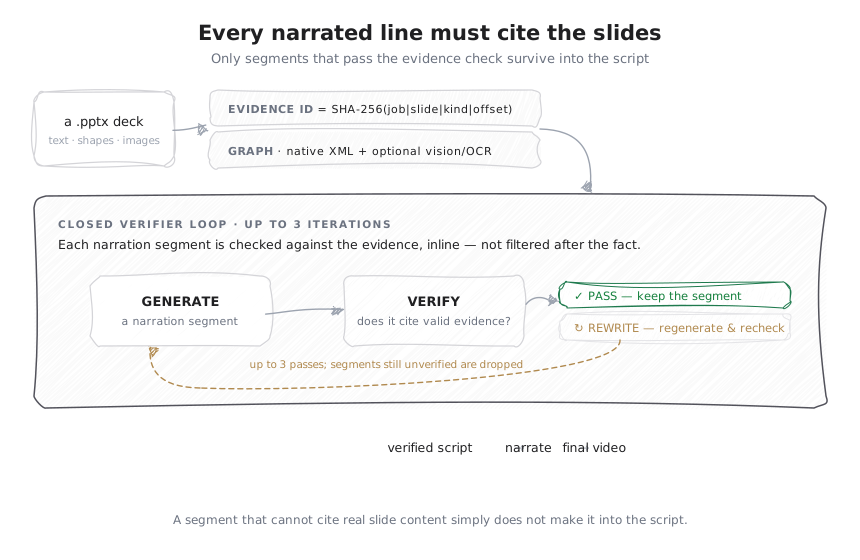
content-addressable evidence ID, computed as SHA-256(job | slide | kind | offset). All downstream narration must cite these IDs, so a claim that cannot
point to real slide content simply cannot survive.
Verifier loop
Narration is not filtered after the fact; it is verified inline. A closed-loop control system generates a script, verifies each segment against the evidence (PASS or REWRITE), regenerates, and re-verifies for up to three passes; segments that never verify are dropped. Optional AI narration then rewrites the evidence-grounded template into natural presenter delivery in a two-pass step.
Dual-provenance knowledge graph
For each slide, two independent graphs are built: one from the PPT XML (shapes, connectors, groups) and one from rendered images plus OCR. They merge into a unified graph where every node carries its provenance (native, vision, or both), a confidence score, and a needs-review flag. The result is a 10-stage pipeline from ingest through evidence, rendering, graphing, scripting, verification, translation, narration, audio, and final video.
Published on PyPI under Apache 2.0, with a citable release archived on Zenodo.

