
Talk2026

Talk· Speaker
Speaking at WeAreDevelopers
Test before release. Enforce at runtime.
Talk on testing agent behaviour before release and enforcing it at runtime.
Sachin Gupta · San Jose
15+ years shipping large-scale billing and financial systems. Currently leading platform reliability and AI-enablement at eBay.
10 of 130
Test before release. Enforce at runtime.
Talk on testing agent behaviour before release and enforcing it at runtime.
Reviewer for IEEE Access, IEEE's multidisciplinary open-access journal, reviewing one submitted manuscript.
Artifact Evaluation Committee member for ACSAC 2026, the 42nd IEEE Annual Computer Security Applications Conference, evaluating two artifacts for reproducibility.
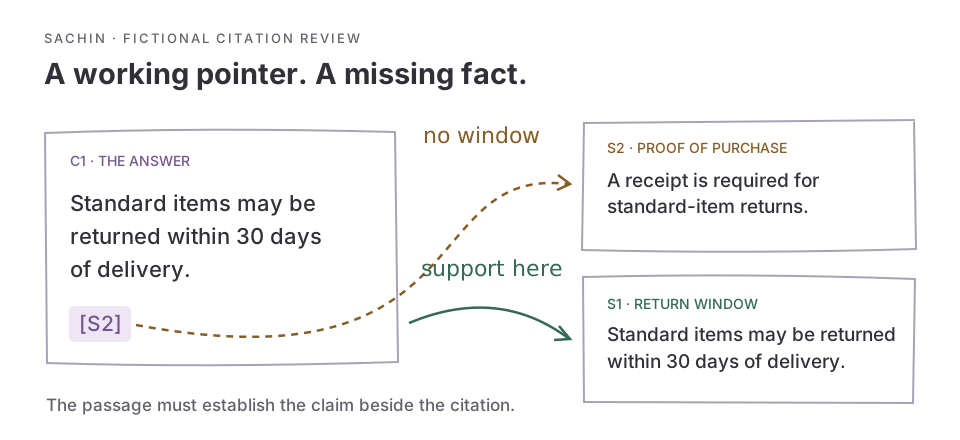
Follow the pointer. Then check the passage.
Review a fictional answer at Sachin. Follow its citations, repair missing support, and inspect how citation recall and precision are calculated. An illustrated review desk and a runnable JavaScript example connect the story to the mechanism.
Reviewer for Global South AI: Rethinking AI for and from the Global South at NeurIPS 2026, reviewing three submitted papers.
Follow one request from the badge desk to the response.
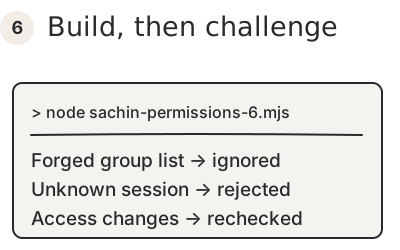
Run a local permission-aware answer service. Test forged group claims, tenant isolation, revoked access, stale caches, and source requests.
Reviewer for the Third Workshop on Agents in the Wild: Safety, Security, and Beyond at NeurIPS 2026 (Sydney), reviewing three submitted papers.
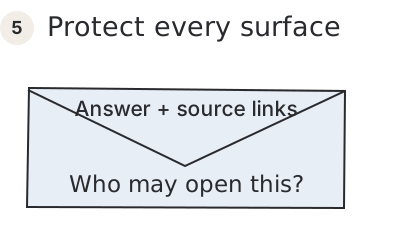
The envelope matters as much as the letter.
Inspect four places information can escape an otherwise filtered answer: citations, previews, shared answers, and diagnostics.
Reviewer for Grounded and Faithful Vision-Language Models for Real-World Deployment (VLM4RWD) at NeurIPS 2026 (Sydney), reviewing three submitted papers.
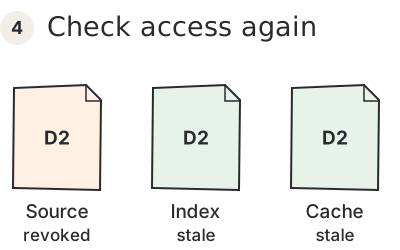
Yesterday’s stamp cannot prove today’s permission.
Step through a permission change at the source, a stale index, and an old cached answer. Learn where current checks belong.