Text Analysis
Before a word can be indexed, it has to be prepared. The quiet pipeline that decides what your search can ever match.

Part of the search series. The inverted index does not store raw text; it stores terms, and text analysis is the pipeline that turns one into the other: tokenize, lowercase, drop stopwords, stem to a root, expand synonyms. The same analyzer must run on the query, and getting it wrong silently breaks search. With an interactive analysis pipeline.
You do not throw whole, unwashed vegetables into a pot. You rinse them, peel them, and chop them into pieces of a consistent size first, because that is what makes them cook evenly. Text analysis does the same to raw text before it is indexed: it takes a messy sentence and turns it into clean, consistent pieces a search engine can actually work with.
In How Search Works the inverted index mapped a word to the documents that contain it. But it does not store the raw word. Between the document and the index sits an analyzer, a small pipeline that decides what a "term" even is. That pipeline quietly sets the ceiling on everything search can match, and most search bugs are really analysis bugs.
Tokenization
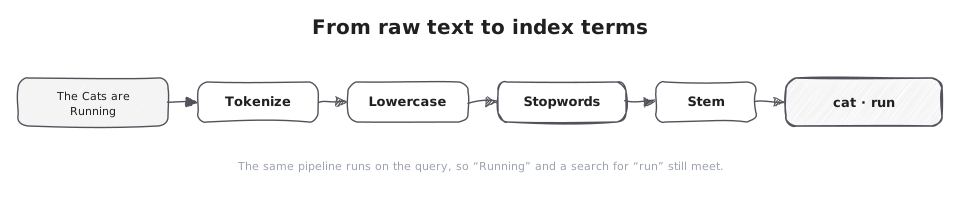
First the text is broken into tokens. "The cats are running." becomes
The, cats, are, running. That sounds trivial until you meet punctuation,
hyphens, URLs, C++, or languages that do not put spaces between words. The tokenizer
is where those decisions get made, and a bad one can split e-mail into e and mail
or lose C# entirely.
Normalization
Next the tokens are made uniform. Lowercasing is the obvious one: without it, Apple
and apple are two different terms and a search for one misses the other. Analyzers
also fold accents (café to cafe), strip diacritics, and normalize width and
punctuation, so that trivial surface differences do not become missed matches.
Stopwords
Some words carry almost no signal. the, a, is, to, of appear in nearly every
document, so matching them tells you nothing and they cost space in every postings
list. Classic search drops these stopwords entirely. Modern engines are often more
careful (removing the from "The Who" or "to be or not to be" destroys the query), but
the idea, spend the index on words that discriminate, is still everywhere.
Stemming and lemmatization
Here is the one that matters most for recall. A user who searches run expects to find
documents that say running, runs, or ran. Left alone, those are four different
terms that never meet. Stemming chops words down to a rough root with fast rules:
running to run, cats to cat, quickly to quick. It is crude and sometimes
over-reaches (universe and university can collapse together), but it is cheap and it
works. Lemmatization is the careful cousin: it uses a dictionary and part-of-speech
to find the real base word, turning better into good and ran into run, at more
cost. Either way, the point is to make different forms of the same idea land on the same
term.
Synonyms
The last common step teaches the index that different words mean the same thing. A
synonym filter expands or rewrites tokens so that NYC also matches New York, and
heart attack also matches myocardial infarction. It is how a search stops depending
on the user guessing the exact word your documents happened to use.
The one rule that breaks everything
Analysis runs in two places, and they must agree. The same analyzer that processed the
document at index time has to process the query at search time. Index Running as
run but search for the raw word running, and you get nothing, because running is
not a key in the index; run is. Almost every "why does my search return zero results"
bug is a mismatch between the index-time and query-time analyzers.
Watch a sentence go through the whole pipeline and turn into the terms that actually get stored:
Analysis is unglamorous and it decides everything. With clean terms in the index, the next question is how to rank the documents that match them, which is where BM25 comes in.